
How to Build a Home Gym: Essential Equipment, Racks and All-in-One Trainers
A useful home gym is not the one with the most equipment. It is the one that fits your space, supports the way you want to train and makes it easier to stay consistent. A spare room, garage or dedicated corner can work well when the equipment is chosen with a clear purpose. The key decisions are what you want to improve, how much room you can give to training and whether a rack, an all in one trainer or a multi station gym best suits your routine.
If you are researching home gym equipment in Australia, start by planning the setup rather than buying individual machines because they are discounted. This guide explains the main equipment choices, what to measure, which accessories are worth prioritising and how to compare products for long term value.
1. Decide What Your Home Gym Needs to Help You Do
Before comparing models, write down the workouts you expect to do most often. Your routine matters more than a long equipment checklist. Someone focused on barbell strength needs a different setup from someone who prefers guided resistance exercises or a household where several people follow different programmes.
For strength training
If squats, bench presses, overhead presses and barbell work are central to your programme, a rack or half rack is a sensible starting point. You will also need to consider a suitable barbell, weight plates, a bench and the safety equipment required for your lifts. Check the stated capacity of the rack, J hooks and safety arms rather than assuming every component has the same rating.
For full body workouts
If you want to train several muscle groups without buying a separate machine for each exercise, an all in one trainer or multi station gym may be more practical. Depending on its attachments, it can support movements such as chest presses, rows, pulldowns, cable flyes and leg exercises. The term “all in one” does not mean every machine offers the same functions, so check the actual specifications.
For a mix of training styles
A combined trainer can suit people who want strength work, cable exercises and guided movements in one area. If you also use free weights, check whether the frame supports the lifts you want and whether there is enough room to use a bench, load plates and move around safely.
A useful test is to list five to eight exercises you expect to do each week, then compare each machine against that list. If a product does not support your regular movements, extra attachments may not justify the cost or space.
2. Measure Your Space Before Choosing Equipment
Measure the available floor area, ceiling height and access route before ordering a large machine. Published dimensions usually describe the assembled equipment, not the full working area you need. You may need additional room to load weight plates, adjust cable pulleys, use a bench, perform lunges or carry equipment into position.
- Equipment footprint: record the length, width and height shown on the product page.
- Working clearance: allow room for the movements you plan to perform, including a bench set away from the frame.
- Ceiling height: check pull up bars, overhead movements and high cable attachments against the room height.
- Floor and access: consider the floor surface, doorways, stairs, delivery route and assembly space.
A compact room may suit a half rack or smaller combined trainer, while a larger garage can offer more flexibility for a functional trainer, bench and free weights. Do not rely on a general room size alone. Compare the exact model dimensions with the space available and leave enough room to use it comfortably.
3. Half Rack, All in One Trainer or Multi Station Gym?
These equipment types can all form the centre of a home gym, but they solve different problems. The right choice depends on the exercises you value, how much guidance you want during a movement and whether you prefer to add equipment gradually or buy a broader setup at once.
A half rack for barbell focused training
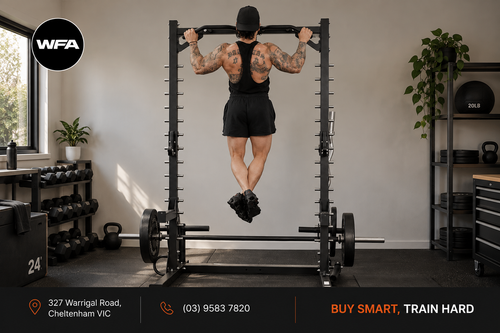
A half rack provides a frame for barbell exercises and usually includes J hooks and safety arms or spotter supports. It is often practical when space is limited and free weight training is the priority. Depending on the model, storage pegs and pull up options may also be included.
A rack does not automatically replace a cable machine or multi station gym. If you want lat pulldowns, cable flyes or seated rows, check whether these functions are supported or whether separate equipment is needed. Include the cost of a bench, barbell and plates if they are not supplied.
An all in one functional trainer for exercise variety
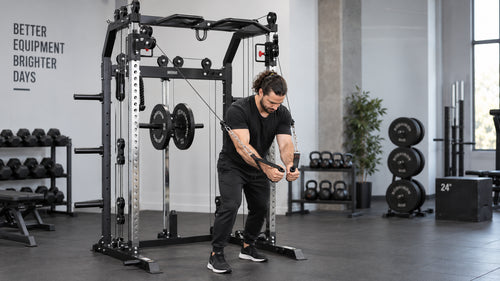
An all in one functional trainer combines several training options within a single frame. Depending on the model, this may include adjustable cable pulleys, a Smith machine, pull up options, dip attachment points and storage for weights or accessories. Adjustable pulleys allow exercises such as chest flyes, rows, triceps pushdowns and cable rotations from different angles.
This type of machine can suit people who want a broad range of exercises without filling a room with separate stations. The trade off is that larger units need more floor space and usually cost more upfront than a basic rack. Compare attachments, weight capacities, cable configuration and dimensions rather than judging a trainer by its feature count.
A multi station gym for guided, varied workouts
A multi station gym groups several exercise stations into one machine, often using an integrated resistance system. Depending on the model, it may provide options such as chest press, lat pulldown, low row and leg exercises. The guided setup can make it easier to move between exercises without changing the whole training area.
It can suit general strength training, beginners who prefer guided movement paths and households wanting several workout options in one machine. Check the stations included, resistance system, seat and adjustment options, and whether it supports the exercises each user expects to perform.
A combined bench and rack for a focused setup
A combined bench and rack can bridge the gap between a basic rack and a larger all in one machine. It can be useful when you want several strength exercises in one footprint, but check what the package includes. Some products include a bench and leg developer, while others require accessories or weight plates to be purchased separately.
4. Which Equipment Should You Buy First?
A staged setup can help manage the cost of building a home gym. Start with the equipment that supports your most frequent workouts, then add pieces when you can identify a clear gap in your routine.
- For barbell strength: prioritise a suitable rack, barbell, plates, bench and necessary safety supports.
- For varied resistance training: compare all in one trainers and multi station gyms by included exercises and attachments.
- For a small training area: look for equipment that replaces separate stations, but confirm its full working footprint.
- For several household users: choose equipment that can be adjusted comfortably and used safely by each person.
- For accessory work: consider dumbbells, resistance bands, a mat and storage once the main setup is in place.
Dumbbells are useful for unilateral exercises and movements that are awkward with a barbell. An adjustable bench adds pressing, supported rowing and other variations to rack-based and cable-based setups. If space is tight, adjustable dumbbells can be easier to store than a full rack of fixed pairs.
5. Understand Weight Ratings, Attachments and Build Quality
Product specifications are most useful when compared with the training you intend to do. A machine may list several weight capacities, and these figures can refer to different parts of the equipment. Read the details for the Smith bar, rack, J hooks, spotter arms, pulley system and weight storage separately where those ratings are provided.
Check what comes in the box. A product image may show a barbell, plates, bench or attachments that are not included. Look for an inclusions list and optional extras section before comparing prices. The cost of the complete setup can differ from the advertised price of the main frame.
Build quality is not determined by one specification alone. Review frame material and dimensions, finish, cable and pulley system, adjustment points, stability features and warranty terms. For a rack, pay particular attention to safety supports and accessory compatibility. For a cable machine, check the pulley arrangement and adjustment range.
6. Home Grade or Commercial Grade Equipment?
The best choice depends on how frequently the equipment will be used and by whom. A person training a few times a week at home may not need the same duty cycle as a gym or personal training studio with many users throughout the day. Commercial grade equipment may be designed for heavier use, but the label alone does not tell you whether a product suits your requirements.
Compare construction, weight capacities, warranty coverage, maintenance requirements and available support. If several people in your household will train regularly, durability and adjustment range may matter more than a long list of features. For a studio or shared training environment, assess the product against expected usage and manufacturer specifications.
7. How to Compare Home Gym Equipment Deals
A large discount can make a product worth considering, but the percentage off should not be the only deciding factor. Compare the current price with specifications, included accessories, warranty terms, delivery costs and the price of any additions needed to use it as intended.
- Confirm that the dimensions fit the planned training area.
- Check that the machine supports your priority exercises.
- Review weight ratings and safety features for your intended use.
- Confirm which accessories are included and which are sold separately.
- Compare warranty terms, delivery options and after sales support.
- Check the current price and stock status on the live product page.
If practical, visiting the World Fitness Australia showroom in Cheltenham, Victoria can help you assess the feel and layout of selected equipment before making a larger purchase. Check current opening details, stock and any showroom pickup offer before travelling, as offers and eligibility can change.
8. A Practical Home Gym Setup Checklist
Use this checklist before placing an order. It turns a broad search for home gym equipment into a decision based on your space, training plan and budget.
- I know which exercises I want to do most weeks.
- I have measured the equipment footprint, working clearance and ceiling height.
- I have checked weight ratings and safety features.
- I know which accessories are included and which are sold separately.
- I have compared the warranty, delivery costs and support options.
- I have checked the delivery route and assembly space.
- I have compared the full setup cost rather than only the headline discount.
The most effective home gym is one you can use consistently. Start with your main training needs, choose equipment that fits the room and leave enough space to move safely. A well matched rack, all in one trainer or multi station gym can provide a strong foundation; accessories can be added as your routine develops.
Frequently Asked Questions
What equipment do you need to build a home gym?
Start with the equipment that supports your main training goals. A barbell focused setup may need a rack, bench, barbell and plates, while an all in one trainer or multi station gym can provide several exercise options in one machine. Measure your space and check what is included before buying.
What is the best home gym equipment for a small space?
The best option fits the available floor area and supports the exercises you do most often. A half rack can suit barbell training, while an all in one trainer may cover more movement types in one footprint. Check the full dimensions and working clearance, not just the product photo.
Is an all in one trainer better than a half rack?
Neither is best for everyone. A half rack suits people who prioritise barbell lifts and want a focused strength setup. An all in one trainer can offer more exercise variety through adjustable cables, a Smith machine or other attachments. Choose based on your training plan, space and budget.
What is the difference between a multi station gym and a functional trainer?
A multi station gym generally provides dedicated exercise stations, often with guided movement paths. A functional trainer uses adjustable cable pulleys that can be set at different heights and angles. Exact options vary by model, so compare the listed stations and attachments.
Can one machine provide a full body workout?
Many all in one trainers and multi station gyms support exercises for several major muscle groups, but the available movements depend on the model and its attachments. Review the exercise options and included accessories to check that they cover your intended routine.
How much space is needed for a home gym?
Space needs depend on the machine and the exercises you plan to perform. Measure the equipment’s length, width and height, then allow clearance for loading plates, adjusting pulleys, using a bench and moving safely. Check ceiling height and the delivery route too.
What should I check before buying a home gym machine on sale?
Compare the current price, dimensions, weight ratings, build details, included accessories, warranty, delivery cost and support. Check whether weights and other items shown in product images are included or sold separately. Confirm current pricing and stock on the live product page.
Should I buy home gym equipment or commercial gym equipment?
Choose based on expected use rather than the label alone. Home equipment may suit individual training a few times a week, while equipment designed for commercial use may suit higher usage or multiple users. Compare construction, ratings, warranty and manufacturer guidance with your needs.
Are weight plates and barbells included with a rack or trainer?
Not always. Inclusions vary by product, and images may show accessories sold separately. Read the inclusions and optional extras sections and confirm compatibility before purchasing plates, barbells or attachments.
Where can I view home gym equipment in Australia?
World Fitness Australia lists home gym racks, all in one trainers and multi station equipment online, and selected products may be available at its Cheltenham, Victoria showroom. Check current stock, showroom availability and opening details before visiting.
Cheltenham VIC ☎ Real questions, real people
(03) 9583 7820 Contact our team →
Leave a comment